
In short
- A fridge-freezer draws about 200 W with the compressor running, but the thermostat switches it off now and then: on average it uses 90 Wh per hour, about 65 kWh a month.
- An inverter model of the same size comes to about 25 kWh a month; a fridge with no freezer, 54; a chest freezer, 81.
- An older 16 cu ft frost-free fridge can reach about 174 kWh a month: nearly 7 times an inverter model.
- The figure for yours is on its energy label (kWh per year): divide it by 12.
Words you’ll see
- Watt (W): how much power an appliance draws at any moment. More in watts, kWh, volts and amps.
- kWh (kilowatt-hour): the energy used over time; it’s what your bill charges for. 1 kWh = 1,000 W for one hour.
- Compressor: the motor that cools the fridge. It uses almost all of the electricity.
- Thermostat: the part that switches the compressor on and off to hold the temperature. That’s why a fridge doesn’t draw its full watts 24 hours a day.
- Inverter: a compressor that doesn’t slam on and off but speeds up or slows down to match the cooling needed.
How many watts does a fridge use?
According to the official table from Argentina’s electricity regulator (ENRE), these are typical wattages and what each one really uses in an hour, counting the time the thermostat has the motor switched off:
| Type | Power | Average use per hour |
|---|---|---|
| Fridge, no freezer | 150 W | 75 Wh |
| Fridge-freezer | 200 W | 90 Wh |
| Fridge-freezer, inverter | 200 W | 35 Wh |
| Chest freezer | 250 W | 113 Wh |
The U.S. Department of Energy wattage table (reproduced by Virginia Tech) lists 725 W for a 16 cubic foot frost-free refrigerator, and explains that although it’s always plugged in, the motor only runs at full power about a third of the time. That’s a large, older model; the Argentine figures are for smaller, current fridges.
How much does it use per month? The math
Average use per hour × 24 hours × 30 days:
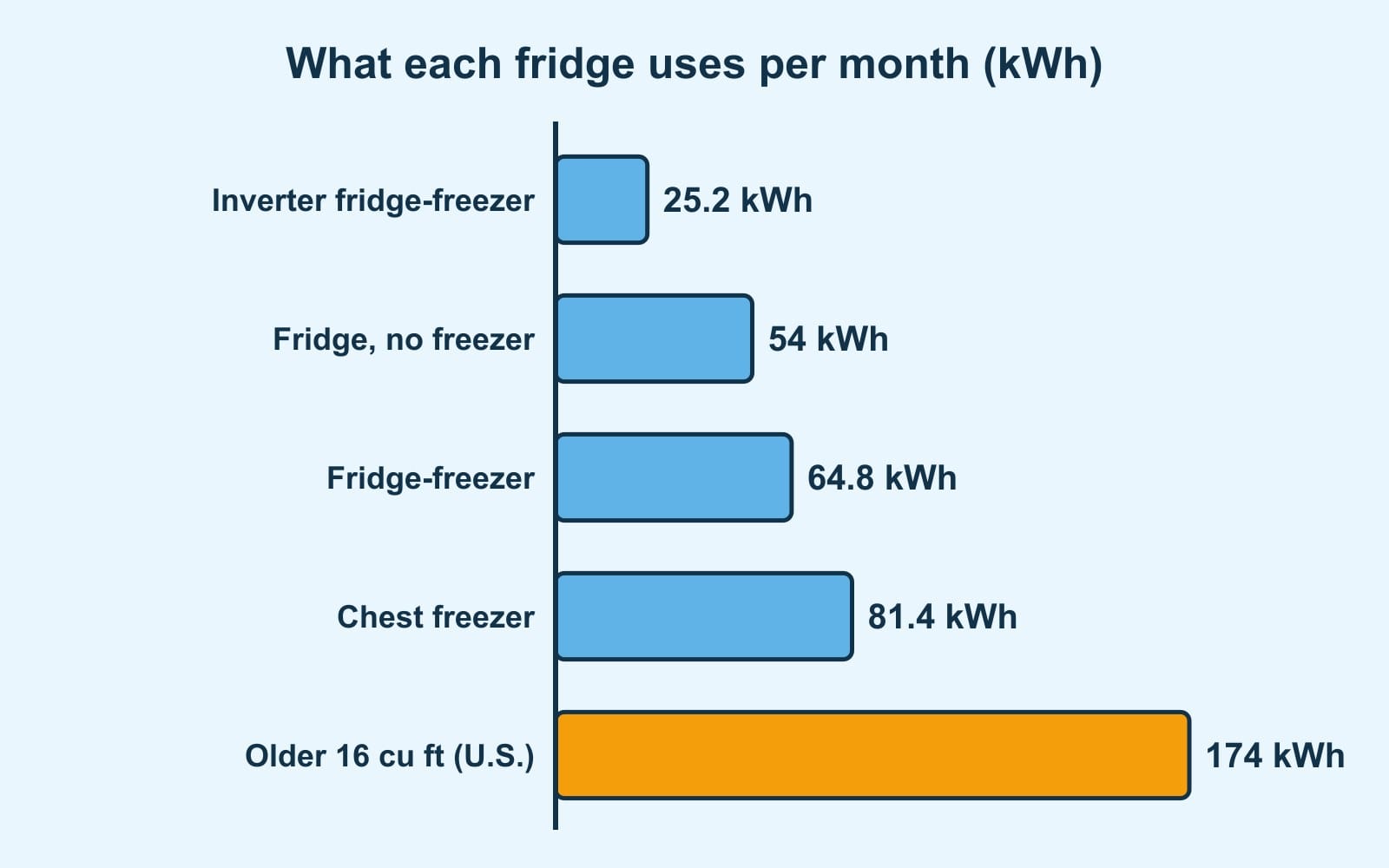
- No freezer: 75 × 24 × 30 = 54 kWh a month.
- Fridge-freezer: 90 × 24 × 30 = 64.8 kWh.
- Inverter fridge-freezer: 35 × 24 × 30 = 25.2 kWh.
- Chest freezer: 113 × 24 × 30 = 81.4 kWh.
- Older 16 cu ft: 725 W × 8 hours at full power (a third of the day) × 30 = 174 kWh.
To see what it costs, multiply the kWh by the price per kWh on your bill. The electricity usage calculator does the math with these same figures.
Does a bigger fridge use more? Cubic feet
Yes: according to ENERGY STAR (the U.S. government’s efficiency program), the larger the refrigerator, the more energy it generally uses, and the most efficient models are typically 16 to 20 cubic feet (16 cu ft is about 453 litres). It also says models with the freezer on top tend to use the least, compared with bottom-freezer and side-by-side models.
There’s no fixed figure per size, though: two 16 cu ft fridges can use very different amounts depending on their age and whether they’re inverter models. For yours, the label is the figure that counts.
Where to find your fridge’s figure
- The energy label (the yellow EnergyGuide label in the U.S., a colour-coded label in many other countries) gives kWh per year. Divide by 12 for the monthly figure. We explain it in how to read an energy label.
- The rating plate inside or on the back gives watts or amps. That’s the draw with the motor running, not the whole day: don’t multiply it by 24 hours.
- To measure it properly, use a plug-in energy meter for a full day. See how to calculate an appliance’s electricity use.
Worked example: replacing an old fridge with an inverter model
- The old one (frost-free, 16 cu ft): 174 kWh a month.
- An inverter fridge-freezer: 25.2 kWh a month.
- Difference: 174 − 25.2 = 148.8 kWh a month, about 1,786 kWh a year.
- At an example price of $0.15 per kWh (use the one on your bill): 148.8 × 0.15 = $22.32 a month saved.
Not every old fridge uses that much: the one in the table is large and old. Check the label or measure yours before you do the math.
What it needs to start (for batteries and generators)
The compressor is a motor and gives a kick of power when it starts. According to the guide from the Eugene Water & Electric Board (EWEB), a public utility in Oregon, a fridge needs about 3 times its running watts to start: for a 200 W fridge, about 600 W more for an instant. If you’ll run it on a generator or a battery with an inverter, they must handle that kick.
Common mistakes
- Multiplying the rating-plate watts by 24 hours. The thermostat switches the motor off at times: a 200 W fridge doesn’t use 4.8 kWh a day but about 2.16.
- Keeping a second, old fridge almost empty. ENERGY STAR recommends retiring fridges over 15 years old: on average an old one uses 20% more energy than a certified model, and a second fridge adds all its use even when it’s nearly empty.
- Buying the biggest one “just in case”. A larger fridge generally uses more.
When to call a technician or an electrician
If the motor never stops, ice forms where it shouldn’t or the plug gets warm, call a refrigeration technician. If the breaker trips when the fridge starts, call an electrician: it may be the outlet or the circuit (see why a breaker trips).
Sources and references
- Ente Nacional Regulador del Gas y la Electricidad (Argentina). Consumo básico de electrodomésticos (wattage and energy per hour of each fridge and the freezer).
- Grisso, R., Walker, M. and Ignosh, J., Virginia Cooperative Extension (Virginia Tech), 2020. Estimating Appliance and Home Electronic Energy Use (U.S. Department of Energy table: 16 cu ft frost-free refrigerator, 725 W; the motor runs at full power a third of the time).
- ENERGY STAR (EPA and U.S. Department of Energy). Refrigerators (size, top freezer, retiring fridges over 15 years old, 20% more energy for older models).
- EWEB (Eugene Water & Electric Board, U.S.). Generator Sizing Considerations (fridge start-up: 2,200 additional watts on 700 running, about 3 times).
- National Institute of Standards and Technology (NIST). Guide to the SI, Appendix B.8 (1 cubic foot = 0.02832 m³, about 28.3 litres).
Frequently asked questions
How many watts does a refrigerator use?
A fridge-freezer draws about 200 W with the motor running, according to Argentina’s ENRE table. Because the thermostat switches it off at times, it averages 90 Wh per hour, about 65 kWh a month.
How much does an inverter fridge use per month?
An inverter fridge-freezer averages 35 Wh per hour: 35 × 24 × 30 = 25.2 kWh a month, less than half a standard one of the same size.
How do I know how much my fridge uses?
Check its energy label: it gives kWh per year, which divided by 12 is the monthly figure. The watts on the rating plate are the motor’s running draw and shouldn’t be multiplied by 24 hours.


