
In short
- A generator has to supply two things: the watts of everything you run at once and, on top, the start-up kick of the hungriest motor (fridge, pump, A/C).
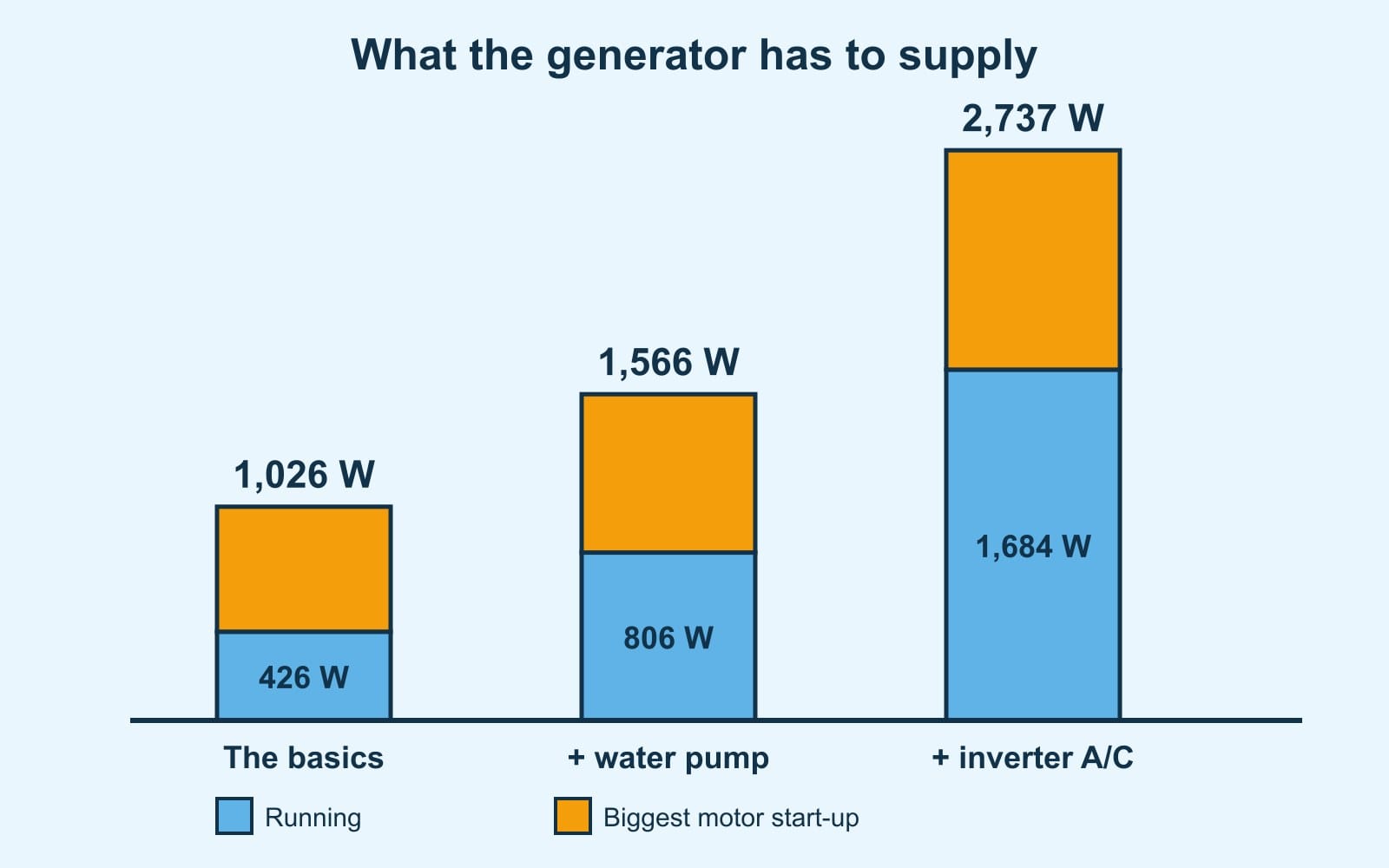
- Fridge, 4 LED bulbs, a fan, 2 chargers and the TV: 426 W running and 1,026 W with the fridge’s start-up.
- With a 1/2 HP water pump: 806 W and 1,566 W. Adding a 2,200-frigorie inverter A/C: 1,684 W and 2,737 W.
- Anything that heats (water heater, space heaters, electric shower) uses so much that it needs a far bigger generator. And the generator always goes outdoors, never connected to your home wiring without an electrician.
Words you’ll see
- Generator: the gasoline, propane or diesel machine that produces electricity.
- Running watts: what an appliance uses while it runs. More in watts, kWh, volts and amps.
- Starting watts: the split-second kick of power a motor (the compressor in a fridge or A/C, a pump) needs to start.
- HP (horsepower): another way to state a motor’s power. A 1/2 HP pump uses about 380 W.
The math: what runs at once, plus one start-up
This is the method in the guide from the Eugene Water & Electric Board (EWEB), a public utility in Oregon:
- List the appliances you want to run at the same time on the generator.
- Add up their running watts.
- Find which of them has the largest additional starting watts and add it to the total. Just one: motors don’t all start at the same instant.
The generator has to supply at least the step 2 total continuously and handle the step 3 total at the moment of start-up. Compare those two figures with the ones on the generator’s spec sheet.
How much each appliance needs to start
Only appliances with a motor give that kick. We use the ratios from EWEB’s table: a fridge needs about 3 times its running watts to start, a water pump 2 times and an air conditioner 1.2 times (EWEB’s figure is for a window unit; your unit’s spec sheet may give another figure). Running watts come from the table of Argentina’s electricity regulator (ENRE), the same one in our appliance energy use chart:
| Appliance | Running | Additional starting |
|---|---|---|
| Fridge-freezer | 200 W | 600 W |
| Freezer | 250 W | 750 W |
| 1/2 HP water pump | 380 W | 760 W |
| 3/4 HP water pump | 570 W | 1,140 W |
| 2,200-frigorie A/C, inverter | 878 W | 1,053 W |
| 2,200-frigorie A/C, standard | 1,350 W | 1,620 W |
| 3,500-frigorie A/C, standard | 2,150 W | 2,580 W |
A 2,200-frigorie unit is about 8,700 BTU; a 3,500-frigorie one, about 13,900 BTU. Bulbs, the TV, chargers and small fans have no start-up kick to count.
Case 1: the basics for a power outage
- Fridge-freezer 200 W + 4 LED bulbs of 9 W (36 W) + pedestal fan 90 W + 2 chargers of 5 W (10 W) + LED TV 90 W = 426 W running.
- The only motor is the fridge’s: 600 W to start.
- 426 + 600 = 1,026 W.
A generator that gives at least 426 W continuously and handles 1,026 W at start-up, with some margin in case you plug in something else. For this, a battery or portable power station also works and gives off no fumes: work out which with the power outage battery calculator.
Case 2: with a water pump
- Case 1 plus a 1/2 HP pump (380 W): 426 + 380 = 806 W running.
- The largest start-up is now the pump’s: 760 W (more than the fridge’s 600).
- 806 + 760 = 1,566 W.
Case 3: with an air conditioner
- Case 2 plus a 2,200-frigorie inverter A/C (878 W): 806 + 878 = 1,684 W running.
- The largest start-up is the A/C’s: 1,053 W.
- 1,684 + 1,053 = 2,737 W.
With a standard (non-inverter) A/C of the same size it would be 2,156 W running and 3,776 W with its 1,620 W start-up. The A/C alone needs more than everything else combined.
Things that heat: the big users
Appliances that heat with electricity have no start-up kick, but they use a huge amount while running. In EWEB’s table, an electric water heater uses 4,500 W and a space heater 1,500 W; an electric shower also uses several thousand watts (check its label). Any one of them needs more than the three cases above. If you need them on the generator, add them like any other appliance and you’ll see you need a much bigger generator; if not, leave them off the list.
Common mistakes
- Forgetting the start-up. With 426 W of appliances, a generator that only gives 500 W may not start the fridge.
- Adding up everything in the house. Only what you’ll run at the same time on the generator counts.
- Running it indoors or in the garage. It gives off carbon monoxide, which kills without a smell: read how to use a generator safely.
- Plugging it into a wall outlet or the panel. According to the US Occupational Safety and Health Administration (OSHA), without a transfer switch installed by an electrician the power can flow out to the utility lines and electrocute the people repairing them. Plug appliances straight into the generator.
When to call an electrician
If you want the generator to power your home’s circuits (not just appliances plugged into it), you need a transfer switch installed by a qualified electrician. They can also tell you which circuits are worth connecting and check what your appliances really use.
Sources and references
- EWEB (Eugene Water & Electric Board, a public utility in Eugene, Oregon). Generator Sizing Considerations (the method and the starting ratios; water heater 4,500 W, space heater 1,500 W).
- Ente Nacional Regulador del Gas y la Electricidad (Argentina). Consumo básico de electrodomésticos (in Spanish; running watts of each appliance).
- Occupational Safety and Health Administration (OSHA), 2005. Using Portable Generators Safely.
- U.S. Consumer Product Safety Commission (CPSC), August 4, 2022. CPSC Releases New Report on Carbon Monoxide (CO) Fatalities, Urges Generator Safety in New PSA.
Frequently asked questions
What size generator do I need to run a fridge?
A fridge-freezer uses about 200 W running and needs about 600 W more to start. With 4 LED bulbs, a fan, 2 chargers and the TV, the generator has to supply at least 426 W continuously and handle 1,026 W when the fridge starts.
Can a generator run an air conditioner?
It depends on its size. A 2,200-frigorie (about 8,700 BTU) inverter A/C uses about 878 W and needs about 1,053 W more to start; together with the fridge, pump and basics that’s 1,684 W running and 2,737 W at start-up.
Can I plug the generator into a wall outlet?
No. According to OSHA, without a transfer switch installed by an electrician the power can flow out to the utility lines and electrocute whoever is repairing them. Plug appliances straight into the generator.


