
In short
- BTU and tons tell you how much a unit cools, not how much electricity it uses. One ton is 12,000 BTU per hour.
- Watts = BTU ÷ efficiency (EER). A 12,000 BTU mini-split draws roughly 800 to 1,850 W at full power, depending on how efficient it is.
- Running 8 hours a day, that unit adds roughly 147 to 332 kWh a month to your bill.
- An inverter unit uses less: in Argentina’s official appliance table, 35% less per hour than the same unit without an inverter.
Words you’ll see
- Watt (W) and kWh: a watt is what an appliance uses at any given moment; a kWh is what it has used in total, and it’s what your bill charges for. We explain both slowly in watts, kWh, volts and amps.
- BTU: a unit of heat. For an air conditioner, BTU per hour tells you how much heat it removes from the room.
- Ton: another way to state cooling capacity: 1 ton = 12,000 BTU per hour.
- Frigorie: the unit used in Argentina and Uruguay; 1 frigorie is about 3.97 BTU.
- EER (or CEER): efficiency: how many BTU of cooling the unit delivers for each watt of electricity. The higher it is, the less it uses.
- Inverter: an air conditioner whose compressor changes speed instead of switching fully on and off.
What a mini-split is
It’s the most common wall-mounted air conditioner, and it has two parts. According to the U.S. Department of Energy (DOE), the outdoor unit holds the compressor and condenser, and the indoor unit blows the air. They’re joined by a conduit that carries the power cable, the refrigerant tubing and the condensate drain through a hole about 3 inches wide in the wall. The outdoor unit can be up to 50 feet away.
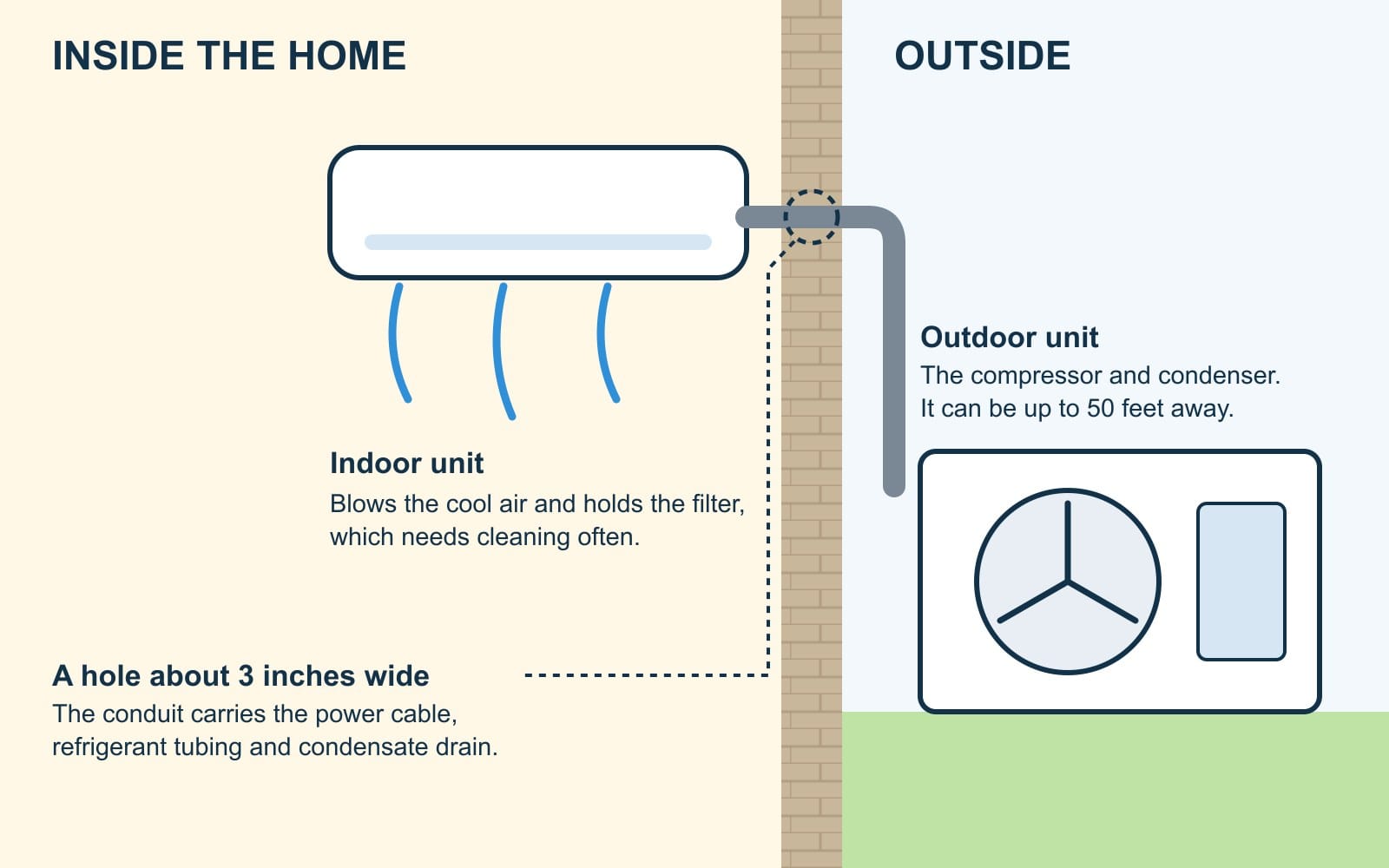
Because it has no ducts running through the house, it only cools the room it’s in. The DOE sees that as an advantage: you can cool only the rooms you’re using.
BTU, tons and frigories: what it cools, not what it uses
When a store says “a 12,000 BTU mini-split” or “a 1-ton unit”, it’s talking about its cooling capacity: how much heat it removes from the room in an hour. According to Penn State University, one ton is 12,000 BTU per hour. The most common sizes:
| Tons | BTU per hour | Frigories per hour |
|---|---|---|
| 0.75 | 9,000 | 2,268 |
| 1 | 12,000 | 3,024 |
| 1.5 | 18,000 | 4,536 |
| 2 | 24,000 | 6,048 |
The most common mistake is thinking a 12,000 BTU unit uses 12,000 watts. It doesn’t: to know what it uses, you need one more number, its efficiency.
From BTU to watts: the maths with efficiency
An air conditioner’s efficiency is measured by its EER: the BTU it removes for each watt it uses (Penn State). So the maths is a simple division:
Watts = BTU per hour ÷ EER
A 12,000 BTU mini-split with an EER of 10.9 draws 12,000 ÷ 10.9 = 1,101 W at full power. With an EER of 14.7, 12,000 ÷ 14.7 = 816 W. It’s the same maths used by the U.S. Department of Energy’s buying guide and by our air conditioner calculator.
Where do you find the EER? On the unit’s label or spec sheet. In the Americas it’s usually given in BTU/Wh (a number like 10 or 12); in Europe and the UK, in W/W (a number like 3): multiply it by 3.412 to turn it into BTU/Wh. If the label gives a SEER, that’s the average efficiency over a whole cooling season: use it to compare units with each other (the higher, the better).
Why it doesn’t always use the same: thermostat and inverter
An air conditioner isn’t at full power all the time: once the room reaches the thermostat setting, the compressor slows down or stops. In the official table of Argentina’s electricity regulator (ENRE), a 2,200-frigorie unit rated at 1,350 W uses 1,013 Wh in an hour, 75% of its power. That’s why our numbers multiply the hours by 0.75.
An inverter unit goes further: its compressor changes speed. The DOE explains that variable-capacity units run often but at very efficient low speeds. In the same ENRE table, the 2,200-frigorie inverter unit uses 658 Wh per hour instead of 1,013: 35% less. The same happens with the 3,500-frigorie units (1,048 Wh instead of 1,613).
How much it uses per month: table by size
Running 8 hours a day for 30 days, at 75% duty, by efficiency. The three efficiencies are the ones in our calculator: the ENERGY STAR minimum (14.7), the U.S. legal minimum for new room units (10.9) and an old non-inverter unit like the one in the ENRE table (about 6.5).
| Unit | Efficient (EER 14.7) | Standard (EER 10.9) | Old (EER 6.5) |
|---|---|---|---|
| 9,000 BTU (0.75 ton) | 612 W · 110 kWh | 826 W · 149 kWh | 1,385 W · 249 kWh |
| 12,000 BTU (1 ton) | 816 W · 147 kWh | 1,101 W · 198 kWh | 1,846 W · 332 kWh |
| 18,000 BTU (1.5 ton) | 1,224 W · 220 kWh | 1,651 W · 297 kWh | 2,769 W · 498 kWh |
| 24,000 BTU (2 ton) | 1,633 W · 294 kWh | 2,202 W · 396 kWh | 3,692 W · 665 kWh |
The watts are what it draws at full power; the kWh, what it adds to your bill each month. If you run it more or fewer hours, the number changes in proportion: 4 hours, half; 16 hours, double.
A worked example: a 1-ton mini-split at night
A bedroom with a 12,000 BTU (1-ton) mini-split of standard efficiency (EER 10.9), running 8 hours every night, with electricity at 0.15 per kWh:
- Watts at full power: 12,000 ÷ 10.9 = 1,101 W.
- Per day: 1,101 × 8 hours × 0.75 ÷ 1,000 = 6.61 kWh.
- Per month: 6.61 × 30 = 198.2 kWh.
- On your bill: 198.2 × 0.15 = 29.73 per month.
The same unit with ENERGY STAR efficiency (EER 14.7) would use 4.90 kWh a day and 146.9 a month: 51.2 kWh less, about 7.68 less every month. You can check it in the calculator with the same numbers.
How to use less
- Set the thermostat as high as is comfortable. That’s the DOE’s advice: the smaller the difference between inside and outside, the less it uses.
- Turn it up when you’re out. The DOE estimates that setting the thermostat back 7 to 10 °F (about 4 to 5.5 °C) for 8 hours a day saves up to 10% a year on heating and cooling.
- Clean the filter. A dirty filter blocks the airflow and lowers efficiency. Unless the manufacturer says otherwise, the DOE advises cleaning or replacing it every month or two while you use it.
- Cool only the rooms you use and keep doors and windows closed.
- Use a fan to spread the cool air: according to the DOE, it does so without significantly increasing electricity use.
Common mistakes
- Buying a bigger one “just in case”. ENERGY STAR and the DOE warn that an oversized unit cools before it removes the humidity, leaves the room cold but clammy and wastes energy. Size it with the calculator.
- Setting the thermostat very low so it cools faster. The DOE is clear: it won’t cool any faster, it just wastes energy.
- Putting a lamp or TV near the thermostat. The heat fools it and the unit runs for no reason (DOE).
- Mixing up BTU and watts. BTU are the cooling it delivers; watts, what it uses.
- Plugging it into a power strip or extension cord. An air conditioner is a major appliance, and the U.S. Fire Administration (USFA) says to plug major appliances directly into a wall outlet. We explain it in the power strip and extension cord calculator.
When to call a technician
Installing a mini-split is not a do-it-yourself job: it involves refrigerant lines and an electrical connection suited to its power. The DOE recommends hiring an experienced installer. Also call a technician if the unit makes strange noises, drips inside the home or cools less and less even with a clean filter.
To see how much the air conditioner weighs on your bill alongside your other appliances, use the electricity usage calculator. And if you’re thinking of running it on solar panels or during a power cut, read how much a solar panel produces and what battery and inverter you’d need.
Sources and references
- U.S. Department of Energy, Energy Saver. Ductless, Mini-Split Heat Pumps (the two units, the conduit, the 3-inch hole, the 50 feet, zones, oversizing and the experienced installer).
- U.S. Department of Energy, Energy Saver. Programmable Thermostats (up to 10% savings with 7–10 °F for 8 hours; a lower setting won’t cool faster).
- U.S. Department of Energy, Energy Saver. Room Air Conditioners (EER, thermostat as high as possible, lamps and TVs near the thermostat, the fan).
- U.S. Department of Energy, Energy Saver. Central Air Conditioning (variable-capacity units and SEER).
- U.S. Department of Energy, Energy Saver. Maintaining Your Air Conditioner (clean or replace the filter every month or two).
- U.S. Department of Energy, FEMP. Purchasing Energy-Efficient Room Air Conditioners (BTU × hours ÷ efficiency; CEER 14.7 and 10.9).
- ENERGY STAR. Room Air Conditioners (proper sizing and oversized units).
- Penn State, EGEE 102. Air Conditioner Efficiency (1 ton = 12,000 BTU per hour; what EER and SEER are).
- Ente Nacional Regulador del Gas y la Electricidad (Argentina). Consumo básico de electrodomésticos (2,200 and 3,500-frigorie units, with and without inverter).
- U.S. Fire Administration (USFA, FEMA). Electrical Fire Safety (major appliances directly into a wall outlet).
- U.S. Energy Information Administration (EIA). British thermal units (Btu).
Frequently asked questions
How many watts does a 12,000 BTU air conditioner use?
It depends on its efficiency: watts = 12,000 ÷ EER. With an EER of 10.9 it draws about 1,101 W at full power; with 14.7, about 816 W; an old non-inverter unit can go over 1,800 W.
How much does a 1-ton mini-split add to the bill?
Running 8 hours a day at standard efficiency (EER 10.9), about 198 kWh a month. Multiply by what you pay per kWh: at 0.15 that’s about 29.73 a month. An efficient one (EER 14.7) uses about 147 kWh.
Does an inverter air conditioner use less?
Yes. In the official table of Argentina’s ENRE, a 2,200-frigorie inverter unit uses 658 Wh per hour versus 1,013 for one without an inverter, 35% less, because its compressor slows down instead of switching on and off.


