
In short
- According to Argentina’s official table (ENRE), a 1/2 HP pump uses about 380 W and a 3/4 HP pump about 570 W.
- One HP is 746 W, so a 1 HP pump delivers about 746 W and a 2 HP pump about 1,492 W. What it draws from the grid is usually somewhat more: the exact figure is on its rating plate.
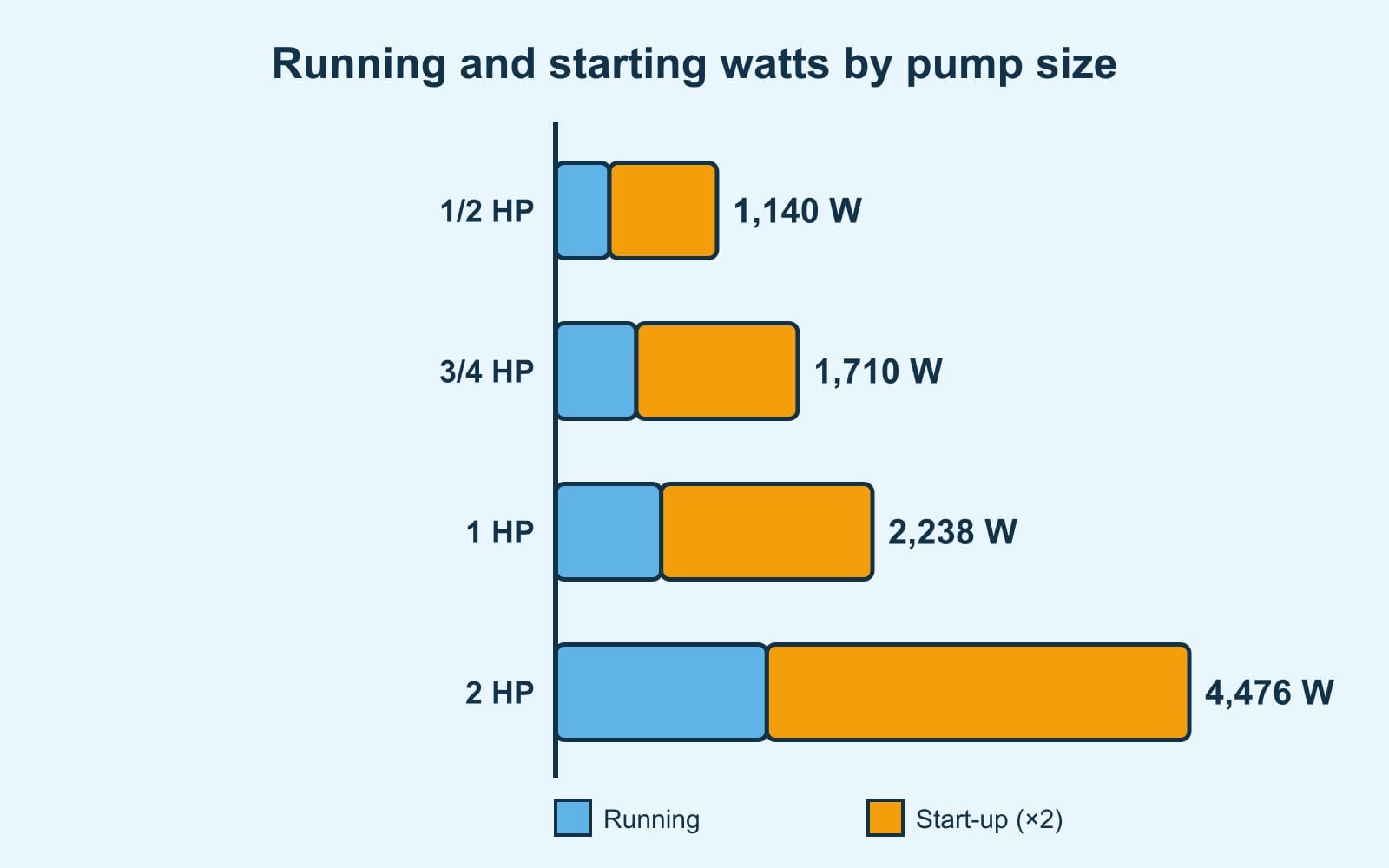
- To start, it needs double its running watts on top: a 1/2 HP pump peaks at about 1,140 W for an instant.
- Monthly use is low if it runs little: pumping 1,000 litres (about 264 gallons) a day with a 1/2 HP pump is about 6.3 kWh a month.
Words you’ll see
- HP (horsepower): another way to state a motor’s power. 1 HP = 746 W.
- Running watts: what the pump uses while it runs. More in watts, kWh, volts and amps.
- Starting watts: the split-second kick of power the motor needs to start.
- Flow rate: how much water the pump moves each minute. It depends on the pump and on how high it lifts the water.
How many watts does each pump use?
| Pump | Running | Additional starting | Start-up peak |
|---|---|---|---|
| 1/2 HP | 380 W | 760 W | 1,140 W |
| 3/4 HP | 570 W | 1,140 W | 1,710 W |
| 1 HP | 746 W | 1,492 W | 2,238 W |
| 2 HP | 1,492 W | 2,984 W | 4,476 W |
The 1/2 and 3/4 HP figures come from the table published by Argentina’s electricity regulator (ENRE). The 1 and 2 HP figures come from the official conversion: according to the U.S. National Institute of Standards and Technology (NIST), 1 electric HP = 746 W. The Argentine table gives almost exactly that for the small pumps (1/2 HP would be 373 W; the table says 380).
Note: horsepower states the power the motor delivers, and no motor turns all of its electricity into work. So what it draws from the grid is usually somewhat more than those watts. The exact figure for yours is on its rating plate (see below).
What it needs to start
The guide from the Eugene Water & Electric Board (EWEB), a public utility in Oregon, lists a well pump at 1,000 W running and 2,000 additional watts to start: double. Applying that to each pump gives the starting column in the table. The kick lasts an instant, but it decides whether a generator or an inverter can handle the pump.
Where to find your pump’s figure
- The rating plate on the motor gives the HP and, almost always, the watts or the amps.
- If it only gives amps, the U.S. Department of Energy table reproduced by Virginia Tech explains the math: amps × volts = watts. For example, 4 A at 120 V is 480 W; 4 A at 240 V, 960 W. It’s an estimate: a watts figure, if there is one, is better.
- The flow rate (gallons or litres per minute) is on the plate or the pump’s spec sheet, sometimes as a table by height. Use the one for the height your water is lifted to.
Worked example: what filling the tank costs per month
A home pumps 1,000 litres (about 264 gallons) a day to its tank with a 1/2 HP pump whose spec sheet says that, at that tank’s height, it moves 30 litres per minute (about 7.9 gallons; it’s an example, check yours).
- Minutes a day: 1,000 ÷ 30 = 33.3 minutes, about 0.56 hours.
- Energy a day: 380 W × 0.56 h = 211 Wh.
- Per month: 211 × 30 = 6.3 kWh.
A 1 HP pump moving twice the water per minute would take half the time: the monthly use would be almost the same. What changes the math most isn’t the pump but how much water you pump each day. Enter your hours in the electricity usage calculator, which includes 1/2 and 3/4 HP pumps.
Why the tables don’t agree
EWEB’s table gives higher figures for small pumps (for example, 1,050 W running for a 1/2 HP sump pump) than Argentina’s (380 W for a 1/2 HP water pump). EWEB’s is meant for choosing a generator with headroom and says it’s only a guide. To know what yours uses, the rating plate or a meter is what counts.
Common mistakes
- Forgetting the start-up. A generator or inverter that supplies 500 W continuously can run a 1/2 HP pump, but not its start-up of about 1,140 W.
- Thinking a bigger pump will use more per month. It uses more per minute, but fills the tank sooner: what matters is the volume of water.
When to call an electrician
A pump has a motor that plugs in or is wired into the house, often near water. Hard-wiring, its protection and grounding are a job for a licensed electrician. Call one too if the breaker trips when it starts or the motor gets very hot.
Sources and references
- Ente Nacional Regulador del Gas y la Electricidad (Argentina). Consumo básico de electrodomésticos (1/2 HP water pump, 380 W; 3/4 HP, 570 W).
- National Institute of Standards and Technology (NIST). Guide to the SI, Appendix B.8 (1 electric horsepower = 746 W).
- EWEB (Eugene Water & Electric Board, U.S.). Generator Sizing Considerations (well pump: 1,000 W running and 2,000 additional starting watts; 1/2 HP sump pump, 1,050 W; a general guide).
- Grisso, R., Walker, M. and Ignosh, J., Virginia Cooperative Extension (Virginia Tech), 2020. Estimating Appliance and Home Electronic Energy Use (amps × volts = watts; deep-well pump, 250–1,100 W).
Frequently asked questions
How many watts does a 1/2 HP water pump use?
About 380 W running, according to Argentina’s ENRE table, and about 760 W more for the instant it starts: a peak of about 1,140 W.
How many watts does a 1 HP pump use?
One HP equals 746 W, so a 1 HP pump delivers about 746 W and needs double that on top to start, a peak of about 2,238 W. What it draws from the grid is usually somewhat more: check its rating plate.
How much does a water pump use per month?
It depends on how many minutes it runs. Pumping 1,000 litres a day with a 1/2 HP pump that moves 30 litres per minute takes 33 minutes a day: about 211 Wh a day and 6.3 kWh a month.


