
In short
- An inverter has two ratings: continuous power (1,000, 2,000, 3,000 W) and surge power, what it can handle for an instant. Your appliances have to fit both.
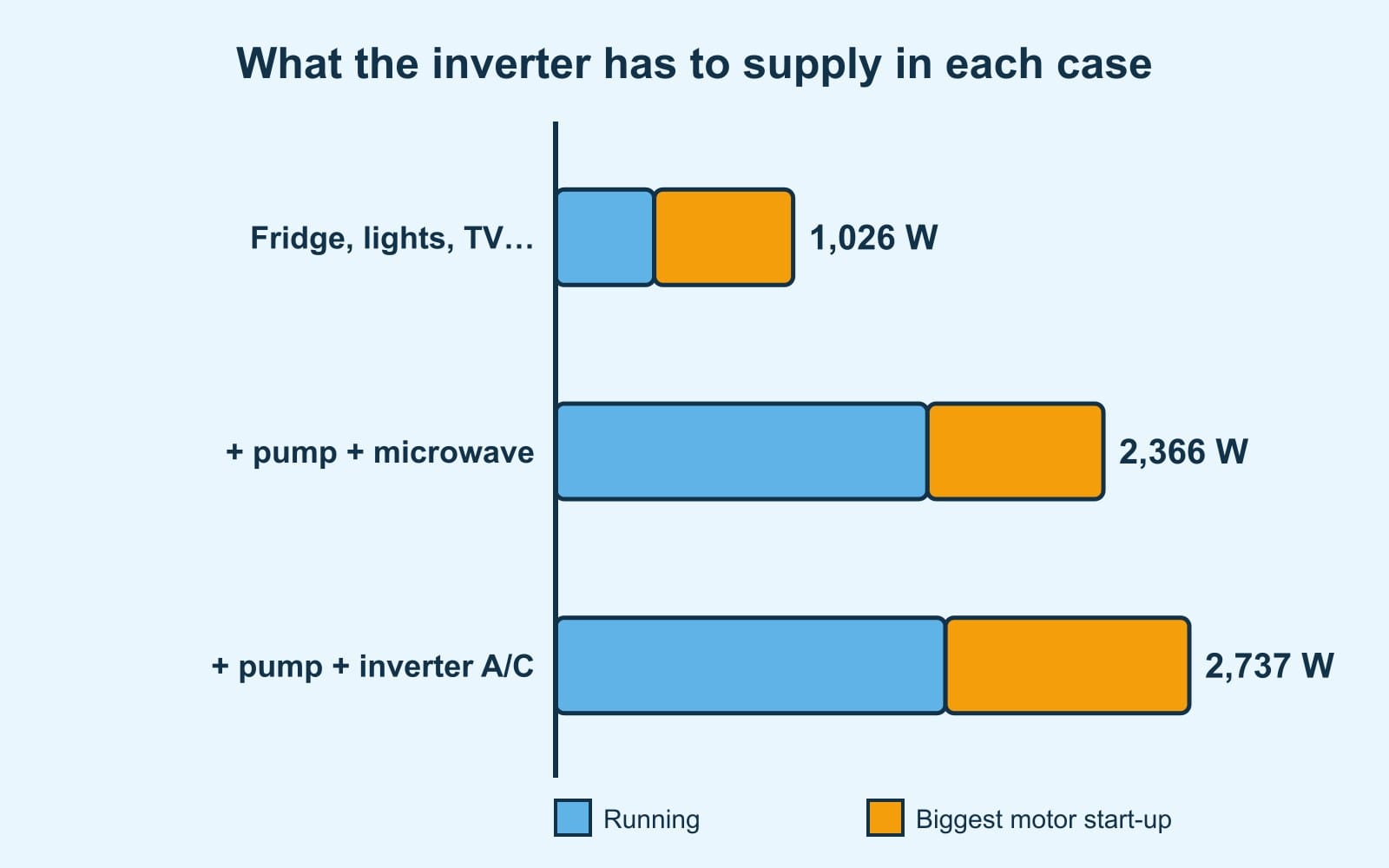
- 1,000 W: fridge, 4 LED bulbs, a fan, chargers and the TV (426 W), if its surge reaches 1,026 W for the fridge’s start-up.
- 2,000 W: all that plus a 1/2 HP water pump and a microwave (1,606 W), with a 2,366 W surge.
- 3,000 W: the basics, the pump and a small inverter A/C (1,684 W, 2,737 W surge). A 4,500 W electric water heater fits on none of them.
Words you’ll see
- Inverter: the device that converts a battery’s power into household outlet power. We explain it in pure sine vs modified sine inverters.
- Continuous power: what the inverter can supply non-stop. It’s the big number in its name.
- Surge (peak) power: what it can handle for an instant, like a motor starting. It’s on the spec sheet.
- Start-up: the kick of power a motor (fridge, pump, A/C) needs to start.
- Watt, amp and volt: more in watts, kWh, volts and amps.
The math: two numbers
It’s the same method the Eugene Water & Electric Board (EWEB), a public utility in Oregon, uses to size a generator:
- Add up the watts of everything you’ll run at the same time. That has to fit the inverter’s continuous power.
- Add the start-up of the hungriest motor (just one: they don’t all start at the same instant). That has to fit the surge power.
The watts come from Argentina’s official appliance table (ENRE) and the start-ups from EWEB’s proportions: a fridge needs about 3 times its running watts, a pump 2 times and an air conditioner 1.2 times. The power outage battery calculator does this math with your appliances.
| Appliance | Running | Additional starting |
|---|---|---|
| Fridge-freezer | 200 W | 600 W |
| 1/2 HP water pump | 380 W | 760 W |
| 8,700 BTU (2,200-frigorie) inverter A/C | 878 W | 1,053 W |
| Microwave | 800 W | — |
| 32" to 50" LED TV | 90 W | — |
| Pedestal fan | 90 W | — |
| LED bulb | 9 W | — |
| Phone charger | 5 W | — |
1,000 W inverter: the basics
- Fridge 200 W + 4 LED bulbs (36 W) + pedestal fan 90 W + 2 chargers (10 W) + TV 90 W = 426 W. Well within 1,000 W.
- The fridge’s start-up: 426 + 600 = 1,026 W. Check that the inverter’s surge reaches that.
The microwave on its own (800 W) also fits, but not together with everything above: 426 + 800 = 1,226 W running.
2,000 W inverter: with a pump and microwave
- The basics plus a 1/2 HP pump and the microwave: 426 + 380 + 800 = 1,606 W running.
- The biggest start-up is now the pump’s (760 W, more than the fridge’s 600): 1,606 + 760 = 2,366 W surge.
3,000 W inverter: with a small A/C
- The basics, the pump and an 8,700 BTU inverter A/C: 426 + 380 + 878 = 1,684 W.
- The biggest start-up is the A/C’s: 1,684 + 1,053 = 2,737 W surge.
It fits a 3,000 W continuous rating; the surge, per the spec sheet. A standard 13,900 BTU (3,500-frigorie) A/C, at 2,150 W in the ENRE table, leaves very little room for anything else.
What fits on none of them
Anything that heats with electricity uses a huge amount: according to the EWEB guide, an electric water heater uses 4,500 W; an electric shower, several thousand (check its label). They don’t fit even a 3,000 W inverter. And even if they did, they’d drain the battery in very little time.
The inverter doesn’t give you hours: the battery does
A 3,000 W inverter doesn’t last longer than a 1,000 W one: how many hours you get depends on the battery. With the basics (426 W), a battery delivering 1,000 Wh would last about 2.3 hours, not counting the fridge cycling off at times. Work out yours in what battery do I need for my inverter.
One more useful bit of math: amps = watts ÷ volts. Drawing 3,000 W from a 12 V battery is 3,000 ÷ 12 = 250 A; at 48 V, 62.5 A. That many amps need very thick cables and protection sized to match.
Common mistakes
- Looking only at continuous power. With 426 W of appliances, a 500 W inverter without enough surge won’t start the fridge.
- Plugging in heating appliances. A 4,500 W water heater doesn’t fit any home inverter of these sizes.
- Thinking a bigger inverter gives more hours. The battery gives the hours.
When to call an electrician
Connecting the inverter to your home’s wiring, instead of plugging appliances into it, is a job for a licensed electrician, and so are the cables and protection between battery and inverter when they carry a lot of amps. If a cable or connection gets hot, disconnect and call a professional.
Sources and references
- EWEB (Eugene Water & Electric Board, U.S.). Generator Sizing Considerations (the two-number method; fridge, pump and A/C start-up; electric water heater, 4,500 W).
- Ente Nacional Regulador del Gas y la Electricidad (Argentina). Consumo básico de electrodomésticos (watts for each appliance).
Frequently asked questions
What can I run on a 1,000 W inverter?
The fridge, 4 LED bulbs, a fan, 2 chargers and the TV: 426 W running. Its surge has to handle about 1,026 W when the fridge starts. The microwave (800 W) fits on its own, but not together with everything else.
Can a 2,000 W inverter run a water pump?
Yes. The basics plus a 1/2 HP pump and a microwave are 1,606 W running, and 2,366 W surge when the pump starts. Check that the inverter’s surge reaches that figure.
Can a 3,000 W inverter run an air conditioner?
A small 8,700 BTU (2,200-frigorie) inverter model at 878 W, yes: with the basics and a pump that’s 1,684 W running and 2,737 W surge. A 4,500 W electric water heater won’t fit.


