
In short
- The math: hours = station Wh × 0.8 × 0.85 ÷ what the fridge uses in an hour. The 0.8 is the share of the battery it’s wise to use and the 0.85 covers what’s lost converting the power for the outlet.
- With 1,024 Wh: a fridge-freezer runs about 7.7 hours; a fridge with no freezer, 9.3; an inverter model, about 20.
- The station has to handle the fridge’s start-up: about 800 W for an instant for a 200 W fridge.
- With the door closed, a fridge keeps food safe for about 4 hours without power: a power station is for longer outages.
Words you’ll see
- Portable power station: a lithium battery with an inverter and outlets in one box. EcoFlow, Bluetti and Jackery are well-known brands; we don’t recommend any.
- Wh (watt-hours): the energy the battery stores. More in watts, kWh, volts and amps.
- Inverter: converts the battery’s power into household outlet power. It loses some energy inside.
- Rated and surge output: what the station supplies continuously and what it can handle for an instant (a motor starting).
The math, step by step
- What your fridge uses in an hour. According to Argentina’s official table (ENRE), on average: no freezer, 75 Wh; fridge-freezer, 90 Wh; inverter fridge-freezer, 35 Wh; chest freezer, 113 Wh. For yours, its label or a meter.
- What you can draw from the station. Its Wh × 0.8 × 0.85. We use the same as the power outage battery calculator: 80% of a lithium battery, to avoid draining it fully (which extends its life, according to Australia’s science agency, CSIRO), and 85% inverter efficiency (the U.S. NREL lab puts it above 90% near full load and lower at light load; we use 85% to be safe).
- Divide step 2 by step 1.
How many hours each fridge runs
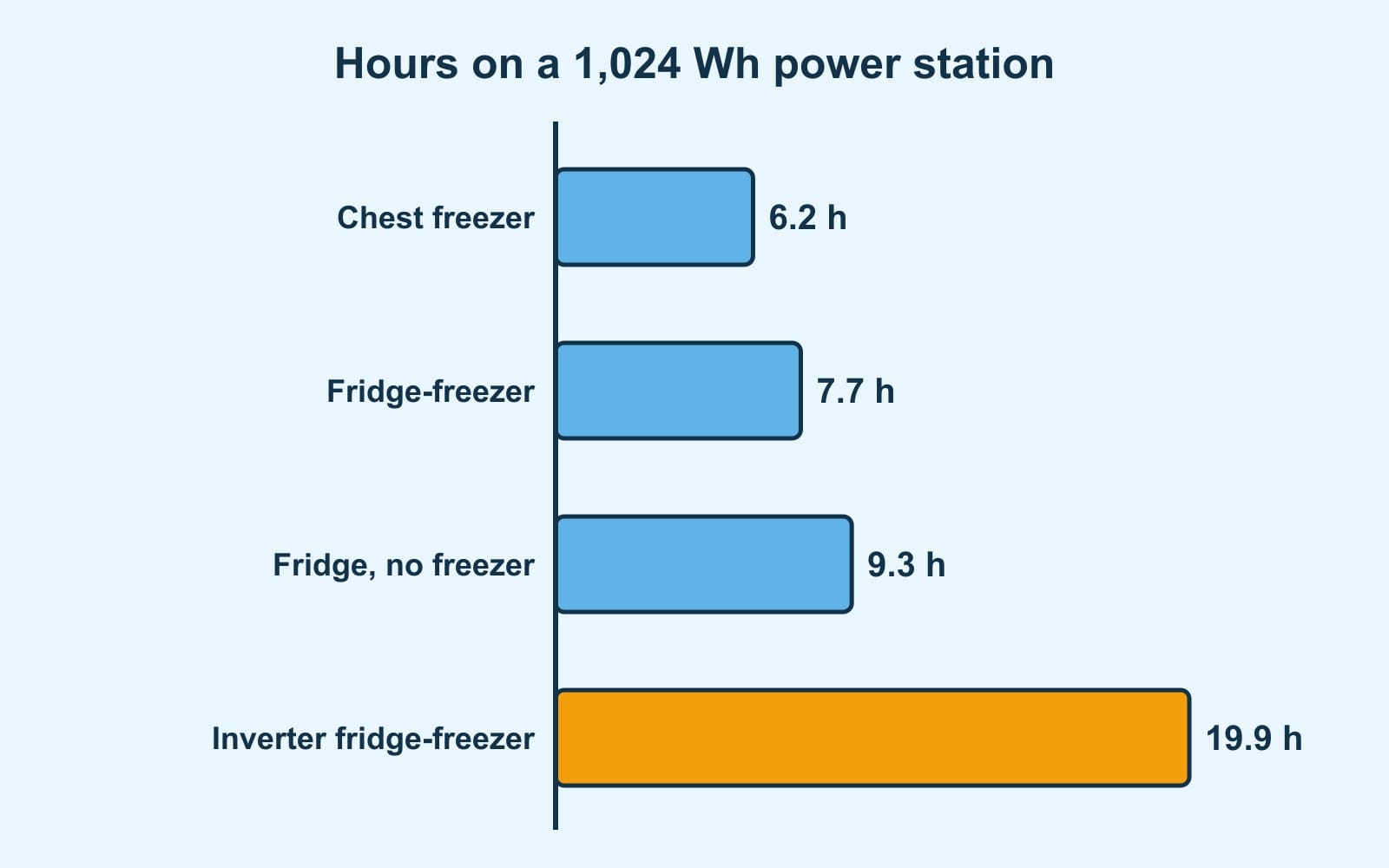
What each one uses per hour: no freezer, 75 Wh; fridge-freezer, 90; inverter, 35; chest freezer, 113. Under each station, the Wh you can draw from it.
| Station | No freezer | Fridge-freezer |
|---|---|---|
| 256 Wh 174 Wh usable | 2.3 h | 1.9 h |
| 512 Wh 348 Wh usable | 4.6 h | 3.9 h |
| 1,024 Wh 696 Wh usable | 9.3 h | 7.7 h |
| 2,048 Wh 1,393 Wh usable | 18.6 h | 15.5 h |
| Station | Inverter fridge-freezer | Chest freezer |
|---|---|---|
| 256 Wh 174 Wh usable | 5.0 h | 1.5 h |
| 512 Wh 348 Wh usable | 9.9 h | 3.1 h |
| 1,024 Wh 696 Wh usable | 19.9 h | 6.2 h |
| 2,048 Wh 1,393 Wh usable | 39.8 h | 12.3 h |
These are the table’s average figures: yours may use more or less. If you can, measure a day’s use with a plug-in energy meter and use that figure.
Start-up: so the station doesn’t shut off
A fridge compressor gives a kick when it starts. According to the guide from the Eugene Water & Electric Board (EWEB), a public utility in Oregon, a fridge needs about 3 times its running watts on top: a 200 W fridge needs about 800 W peak (200 + 600) for an instant; a 150 W one, about 600 W. Check the station’s surge (peak) output on its spec sheet: it has to reach that.
Worked example: an 8-hour outage
A home wants to keep its fridge-freezer running through an 8-hour outage:
- The fridge uses 90 Wh × 8 h = 720 Wh.
- The battery has to deliver 720 ÷ 0.85 = 847 Wh (for the inverter’s losses).
- Using 80%: 847 ÷ 0.8 = 1,059 Wh of station capacity at minimum.
- A 1,024 Wh station falls short (7.7 hours); a 2,048 Wh one has room to spare for lights or charging phones.
If you also want lights, a fan or phone charging, add them in the calculator: it does this same math with everything together.
Does the fridge need power for the whole outage?
Not always. According to the U.S. Department of Agriculture (USDA) and FoodSafety.gov, with the door closed a fridge keeps food safe for about 4 hours, and a full freezer for about 48. In a short outage, the most important thing is not to open it. See how long food lasts in the fridge without power.
Common mistakes
- Dividing the station’s Wh by the 200 W on the rating plate. A fridge doesn’t draw its full watts all the time: on average, 90 Wh each hour. That method gives less than half the real run time.
- Counting on 100% of the battery. The inverter loses energy converting the power, and draining the battery fully shortens its life.
- Looking only at Wh and not at surge. If the station can’t handle the start-up, it shuts off even when full.
Safety
You use a portable power station by plugging appliances into it. Connecting it to your home’s wiring (for example, to power a circuit) is a job for a licensed electrician. And unlike a generator, it gives off no fumes: it can be used indoors.
Sources and references
- Ente Nacional Regulador del Gas y la Electricidad (Argentina). Consumo básico de electrodomésticos (energy per hour of each fridge and the freezer).
- EWEB (Eugene Water & Electric Board, U.S.). Generator Sizing Considerations (fridge start-up: about 3 times its running watts).
- National Renewable Energy Laboratory (NREL), November 2000. Renewable Energy for Rural Schools (inverters exceed 90% efficiency near full load and less at light load; 85% is our own conservative assumption).
- CSIRO (Australian Government), 2021. Batteries for Homes (shallower discharge extends battery life).
- FoodSafety.gov (U.S. Government), last reviewed August 8, 2024. Food Safety During Power Outage and USDA. Keep Your Food Safe During Emergencies (4 hours with the fridge closed; 48 for a full freezer).
Frequently asked questions
How long will a 1,000 Wh power station run a fridge?
With a 1,024 Wh station, using 80% of it and 85% inverter efficiency, you can draw about 696 Wh: a fridge-freezer averaging 90 Wh per hour runs about 7.7 hours; an inverter model, about 20.
What size power station do I need for a fridge?
Multiply what your fridge uses in an hour by the outage hours and divide by 0.85 and by 0.8. For 8 hours with a fridge-freezer: 720 ÷ 0.85 ÷ 0.8 = about 1,059 Wh. And its surge output should reach about 800 W for the start-up.
Can a portable power station handle a fridge’s start-up?
A 200 W fridge needs about 600 W more for an instant when it starts, according to the EWEB guide: about 800 W peak. Check that the station’s surge output reaches that figure.


