
In short
- Panels are sized from how much your home uses (the kWh on your bill), not from its square footage.
- In the US, a home of 3,000 sq ft or more uses on average only 2.3 times as much electricity as one under 1,000 sq ft, even though it’s more than three times bigger. Climate, how many people live there and whether you cook or heat water with gas matter as much as size.
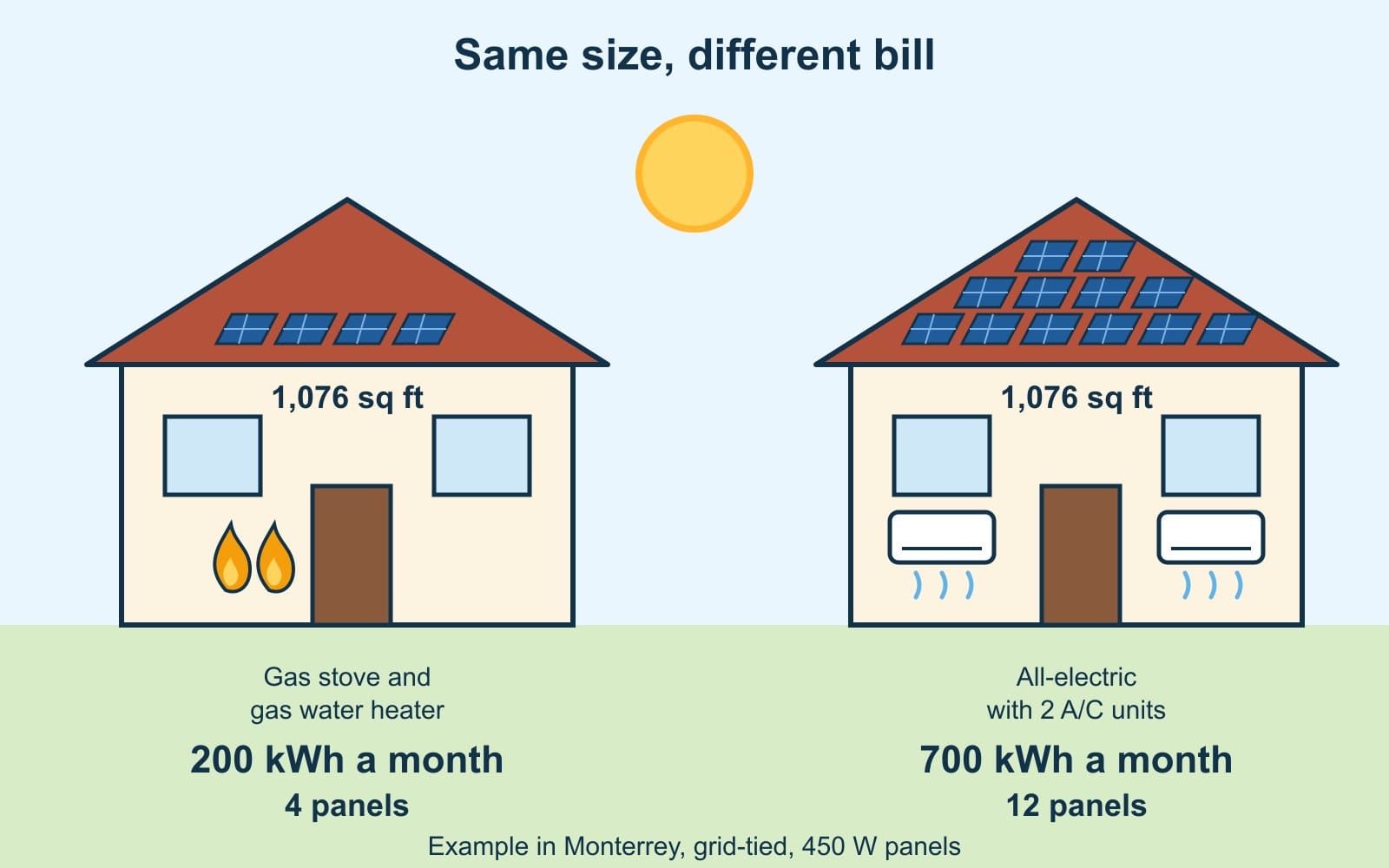
- In Monterrey, Mexico, grid-tied, a home using 200 kWh a month needs 4 panels of 450 W; another of the same size using 700 needs 12.
- The square footage that does matter is the roof’s: each 450 W panel takes up about 21 sq ft (2 m²).
Words you’ll see
- kWh: the total electricity used, the one your bill charges for. If it’s new to you, see watts, kWh, volts and amps.
- kWp (kilowatt peak): the size of a solar system, the sum of its panels’ watts. One 450 W panel is 0.45 kWp; four, 1.8 kWp.
- Grid-tied: the home stays connected to the utility, which supplies whatever is missing. Off-grid: panels and batteries only.
- Panel efficiency: the share of sunlight a panel turns into electricity.
Why square footage doesn’t tell you how many panels you need
Panels have to produce the electricity you use, and what a home uses depends on much more than its size. The US government’s household survey (RECS 2020, from the Energy Information Administration, EIA) shows it with data from thousands of homes:
| Home size | Electricity per year | Per month |
|---|---|---|
| Under 1,000 sq ft | 6,802 kWh | 567 kWh |
| 1,000 to 1,499 sq ft | 9,407 kWh | 784 kWh |
| 1,500 to 1,999 sq ft | 11,009 kWh | 917 kWh |
| 2,000 to 2,499 sq ft | 12,173 kWh | 1,014 kWh |
| 2,500 to 2,999 sq ft | 13,031 kWh | 1,086 kWh |
| 3,000 sq ft or more | 15,489 kWh | 1,291 kWh |
The biggest homes use more, but far less than they grow: 15,489 ÷ 6,802 = 2.3 times, with more than three times the floor area. And in the same survey, other things weigh as much as size:
- Climate: homes in hot-humid climates use 13,781 kWh a year on average; homes in the mild marine climate, 8,410. That’s 64% more.
- People: a one-person household uses 7,184 kWh a year; a five-person one, 14,336. Twice as much.
- What heats and cools: space heating, air conditioning and water heating make up 44% of the electricity used in US homes. If your stove and water heater run on gas, that part isn’t on your power bill.
These are US averages, and US homes use a lot: in the European Union, the average home uses about 300 kWh a month, according to the Odyssee-Mure project. But the point holds everywhere: floor area doesn’t tell you how much you use.
What you do need: how much your home uses
It’s on your electricity bill: the kWh you’re charged for each period. Ideally, look at a whole year, because air conditioning and heating make some months use much more than others. Add up 12 months of kWh and divide by 12.
If it’s a new home or you don’t have bills, you can estimate it by adding up what each appliance uses with the electricity usage calculator, as we explain in how to calculate your appliances’ usage.
The math, in three steps
- What your home uses per day: the kWh per month ÷ 30.4 (the average days in a month).
- What 1 kWp produces per day where you live: the World Bank’s Global Solar Atlas yearly figure ÷ 365, and if the panels go on a roof, × 0.96 (in the Atlas’s own examples, a rooftop system gives 3–4% less). Your city’s figure is in how much a solar panel produces where you live.
- The panels: step 1 ÷ step 2 gives the kWp; × 1,000 ÷ each panel’s watts, rounding up.
It’s the same math the solar panel calculator does, and it also tells you the batteries if you’re off-grid.
Worked example: two 1,076 sq ft homes in Monterrey
Take two identical 1,076 sq ft (100 m²) homes in Monterrey, Mexico, both grid-tied. The first cooks and heats water with gas and has no A/C: it uses 200 kWh a month. The second is all-electric with two mini-splits: it uses 700 kWh a month. In Monterrey, 1 kWp produces 1,638 kWh a year: 1,638 ÷ 365 × 0.96 = 4.31 kWh a day on a roof.
The gas home:
- Daily use: 200 ÷ 30.4 = 6.58 kWh.
- kWp: 6.58 ÷ 4.31 = 1.53 kWp.
- 450 W panels: 1,527 ÷ 450 = 3.39 → 4 panels.
The all-electric home with two A/C units:
- Daily use: 700 ÷ 30.4 = 23.03 kWh.
- kWp: 23.03 ÷ 4.31 = 5.35 kWp.
- 450 W panels: 5,345 ÷ 450 = 11.88 → 12 panels.
Three times the panels with the same floor area. Off-grid, you need more panels plus batteries: you size for the worst month of the year and for what the battery loses, as we explain in how much a solar panel produces.
Table: 450 W panels by how much you use
Grid-tied, on a roof, with sunshine data from the Global Solar Atlas:
| City | 150 kWh/month | 300 | 500 | 800 |
|---|---|---|---|---|
| Mexico City | 3 | 5 | 8 | 13 |
| Madrid | 3 | 6 | 9 | 14 |
| Monterrey | 3 | 6 | 9 | 14 |
| Santo Domingo | 3 | 6 | 9 | 14 |
| Miami | 3 | 6 | 9 | 14 |
| Buenos Aires | 3 | 6 | 9 | 14 |
| Houston | 3 | 6 | 10 | 16 |
| Bogotá | 3 | 6 | 10 | 16 |
| Lima | 3 | 6 | 10 | 16 |
| London | 5 | 9 | 14 | 22 |
Notice that usage changes the result far more than the city does: going from 150 to 800 kWh a month takes you from 3 panels to 13 or 16.
Where square footage does matter: the roof
The area that counts is where the panels go. A 450 W panel takes up about 21 sq ft (2 m²). The math: in full laboratory sunlight, 1,000 W fall on each m² (that’s how panels are rated), and panels sold today turn on average 22.7% of it into electricity, according to the Fraunhofer ISE institute. So 450 ÷ (0.227 × 1,000) = 1.98 m², about 21 sq ft. With the least efficient panels on the market (18.9%) it would be 2.38 m², about 26 sq ft. The exact size is on each panel’s datasheet.
The 12 panels of the home with A/C take up 12 × 1.98 = 24 m² (256 sq ft), up to 29 m² (307 sq ft) with low-efficiency panels. A single-story 1,076 sq ft home usually has roof to spare; it may fall short if the home has several stories, if the roof is shaded or if part of it faces away from the sun. Besides the panels, the installer will leave room for edges and access.
Common mistakes
- Sizing by square footage. As the EIA survey shows, floor area doesn’t tell you how much you use: go by the kWh on your bill.
- Looking at a single bill. Air conditioning and heating are almost a third of the electricity used in US homes, and they’re concentrated in a few months: one month alone can leave you short or oversized.
- Forgetting shade. The Atlas figures don’t include shade from trees, buildings or chimneys, which can cut production a lot.
- Comparing quotes by number of panels only. What matters is the total kWp: 10 panels of 400 W are 4 kWp, less than 9 of 450 W (4.05 kWp).
When to call an installer
Always, for the installation itself. Connecting panels to your home, let alone to the grid, is a job for a qualified installer or electrician, and if you’re grid-tied, your utility has to approve it. With this math you’ll know what size system makes sense and can compare quotes with confidence. To see all the parts, read what’s in a solar kit.
Sources and references
- U.S. Energy Information Administration (EIA). Residential Energy Consumption Survey (RECS) 2020, tables CE2.1 (electricity by home size, climate and household members) and CE4.1 (what the electricity is used for). Released in 2023, revised March 2024.
- Odyssee-Mure (European Commission project). Electricity consumption per dwelling.
- World Bank and ESMAP, data by Solargis. Global Solar Atlas 2.0 (output per kWp for each city, data version 1.7) and its methodology.
- Fraunhofer ISE, July 14, 2026. Photovoltaics Report (average efficiency of silicon panels: 22.7%, between 18.9% and 24.8%, at the end of 2024).
- C. Honsberg and S. Bowden, PVEducation. Solar Cell Efficiency (panels are rated under 1,000 W of light per m²).
Frequently asked questions
How many solar panels does a 1,000 sq ft house need?
It depends on how much it uses, not on its size. In Monterrey, grid-tied, a 1,076 sq ft home using 200 kWh a month needs 4 panels of 450 W, and an identical one using 700 kWh needs 12. Check the kWh on your bill and do the math.
How much space does a solar panel take up?
A 450 W panel takes up about 21 sq ft (2 m²) at today’s average panel efficiency (22.7%, according to Fraunhofer ISE), and up to about 26 sq ft with the least efficient ones. The exact size is on its datasheet.
How do I know how many kWh my home uses?
It’s on your electricity bill. Best is to add up a year’s kWh and divide by 12, because air conditioning and heating make some months use much more than others.


