
In short
- It takes three calculations: how much your A/C uses per day, how much a panel produces where you live, and a division.
- A 12,000 BTU (1-ton) mini-split of standard efficiency, 8 hours a day, uses about 6.6 kWh a day. In Mexico City, with the grid as backup, that’s 4 panels of 450 W.
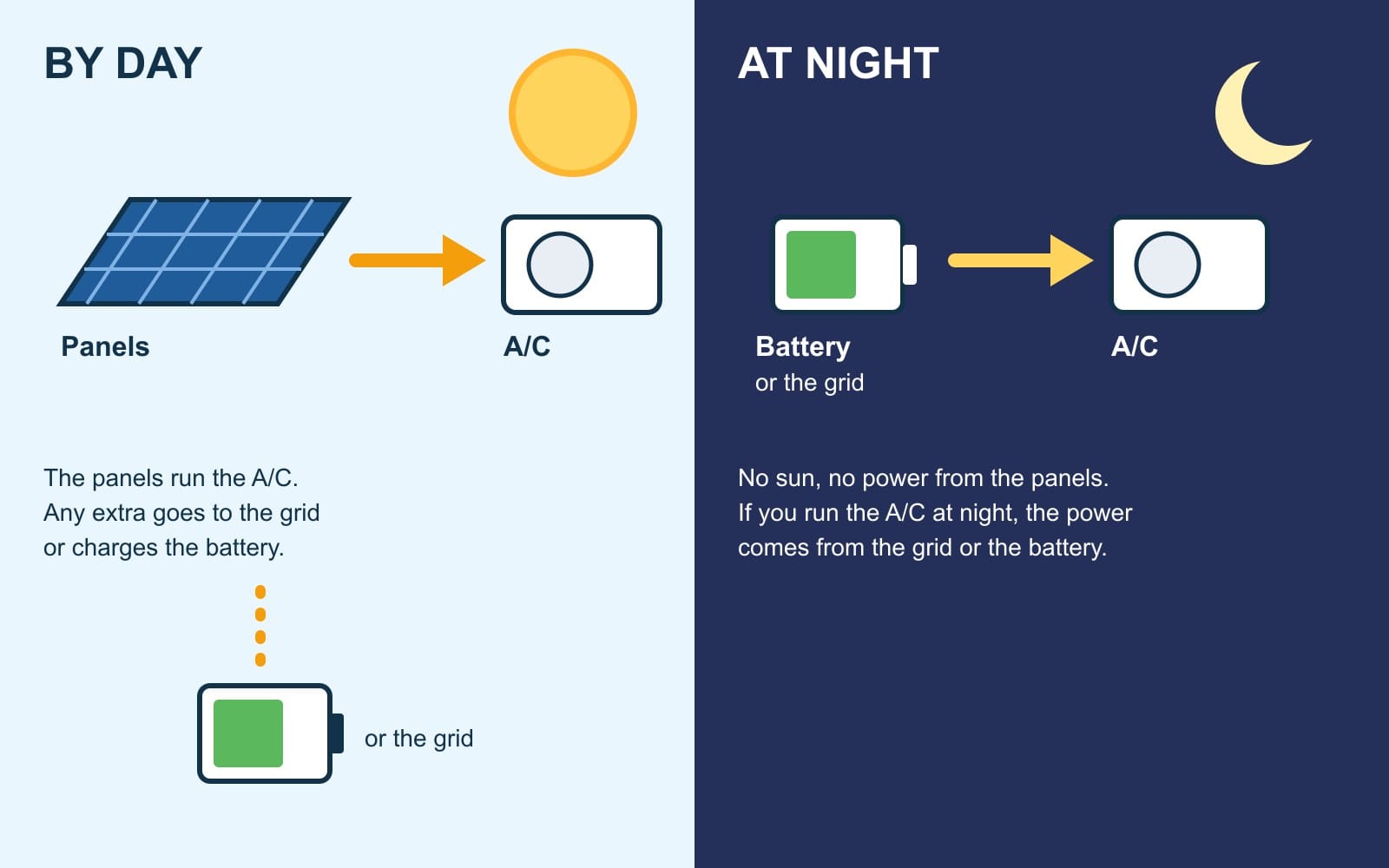
- Panels don’t produce at night. If you run it at night without the grid, you need more panels and a large battery: about 9.7 kWh of lithium for one night.
- The inverter has to handle the compressor’s start-up: more than twice what it uses while running.
Words you’ll see
- kWh: the total electricity used, the one your bill charges for. If it’s new to you, see watts, kWh, volts and amps.
- kWp (kilowatt peak): the size of a solar system, the sum of its panels’ watts. One 450 W panel is 0.45 kWp; four, 1.8 kWp.
- Grid-tied: the home stays connected to the power company, which covers whatever is missing. Off-grid: panels and batteries only.
- Inverter: the device that turns the power from the panels or batteries into the power at your outlets. We explain it in which inverter to choose.
- Start-up (surge): the burst of power a motor (the A/C compressor) draws when it switches on.
Calculation 1: how much your A/C uses per day
This comes first, and we explain it step by step in how much electricity an air conditioner uses. In short: watts = BTU ÷ efficiency (EER), and per day, watts × hours × 0.75 ÷ 1,000 (with the thermostat, the compressor isn’t at full power all the time).
A 12,000 BTU mini-split with an EER of 10.9 running 8 hours: 12,000 ÷ 10.9 = 1,101 W, and 1,101 × 8 × 0.75 ÷ 1,000 = 6.61 kWh a day.
Calculation 2: how much a panel produces where you live
It depends enormously on the place. The World Bank’s Global Solar Atlas gives, for each location, how many kWh each kWp of panels produces per year. In Mexico City it’s 1,814; in Madrid, 1,655; in Lima, 1,397. We go into detail in how much a solar panel produces by location.
To turn it into a day, divide by 365, and if the panels are on the roof, take off 4% (in the Atlas examples, a roof produces 3–4% less than panels on the ground at the best tilt). In Mexico City: 1,814 ÷ 365 × 0.96 = 4.77 kWh per kWp per day.
Calculation 3: the division
kWp needed = kWh per day ÷ kWh that 1 kWp produces per day. And for the number of panels: kWp × 1,000 ÷ the watts of each panel, rounded up.
Worked example: a 1-ton mini-split in Mexico City
With the grid as backup (the most common case for a connected home):
- Use: 6.61 kWh per day.
- Production: 1,814 ÷ 365 × 0.96 = 4.77 kWh per kWp per day.
- kWp: 6.61 ÷ 4.77 = 1.38 kWp.
- 450 W panels: 1,385 ÷ 450 = 3.08 → 4 panels (1.8 kWp).
Over a year, those 4 panels would produce about 3,135 kWh, more than the 2,411 the A/C uses. But note: they produce by day and the A/C runs at night, so the home draws from the grid at night and sends it the surplus by day. How that shows up on your bill depends on your power company.
Off-grid, with panels and batteries only, the calculation changes in two ways. It’s done with the worst month of the year (in Mexico City, September: 4.34 kWh per kWp per day), and it takes off what’s lost storing the power in the battery and taking it out again: 15% (the U.S. national laboratory NLR puts home batteries at 85% efficiency):
- Production: 4.34 × 0.96 × 0.85 = 3.54 kWh per kWp per day.
- kWp: 6.61 ÷ 3.54 = 1.87 → 5 panels of 450 W.
- Battery for one night: 6.61 kWh ÷ 0.85 (the inverter) ÷ 0.8 (you use 80% of a lithium battery) = 9.7 kWh. With 5 panels the system would run at 24 V, so that’s about 405 Ah at 24 V. With lead-acid batteries, of which you use 50%, you’d need 15.5 kWh.
The solar panel calculator gives you all of this with the same numbers.
Table: 450 W panels by A/C size
Running 8 hours a day, in Mexico City, with the panels on the roof. The first number is with the grid as backup; the second, off-grid (which also needs the battery).
| A/C | Efficient (EER 14.7) | Standard (EER 10.9) |
|---|---|---|
| 9,000 BTU (0.75 ton) | 3.67 kWh/day · 2 / 3 panels | 4.95 kWh/day · 3 / 4 panels |
| 12,000 BTU (1 ton) | 4.90 kWh/day · 3 / 4 panels | 6.61 kWh/day · 4 / 5 panels |
| 18,000 BTU (1.5 ton) | 7.35 kWh/day · 4 / 5 panels | 9.91 kWh/day · 5 / 7 panels |
| 24,000 BTU (2 ton) | 9.80 kWh/day · 5 / 7 panels | 13.21 kWh/day · 7 / 9 panels |
Table: the same A/C in 10 cities
1-ton mini-split, standard efficiency, 8 hours a day (6.61 kWh), 450 W panels on the roof. Sunshine data from the Global Solar Atlas.
| City | Grid-tied | Off-grid |
|---|---|---|
| Mexico City | 4 panels | 5 panels |
| Monterrey | 4 | 5 |
| Santo Domingo | 4 | 5 |
| Havana | 4 | 5 |
| Miami | 4 | 5 |
| Madrid | 4 | 6 |
| Bogotá | 4 | 6 |
| Buenos Aires | 4 | 6 |
| Houston | 4 | 6 |
| Lima | 4 | 8 |
With the grid, the difference between cities is small because the yearly average is what counts. Off-grid, the worst month rules: in Lima the winter is very overcast and you need twice the panels.
The start-up: what people forget most
When it switches on, an A/C compressor draws a burst of power. In the table from Eugene’s public power utility (EWEB, U.S.), a window air conditioner draws about 1.2 extra watts at start-up for every watt it uses while running. Using the same ratio, the mini-split in the example would draw 1,101 × 1.2 = 1,321 W more, about 2,422 W in total for an instant. The inverter has to handle that peak; otherwise it shuts off every time the A/C starts. The battery calculator adds that start-up for you.
Common mistakes
- Forgetting the night. Panels don’t produce without sun: if the A/C runs at night and there’s no grid, you need a battery.
- Sizing an off-grid system with the best month. Size it with the worst one, or it won’t keep up that month.
- Not counting the compressor’s start-up when choosing the inverter.
- Looking for “one panel per so many BTU”. There’s no such rule: it depends on the A/C’s efficiency, the hours and your city’s sunshine.
- Connecting panels to the home’s wiring without asking. On the grid, the inverter has to be a model your power company accepts: ask them before you buy.
When to call an installer
Always, for the installation. Panels, batteries and the inverter work with high direct current and connect to the home’s wiring: a qualified installer has to set them up, and if the home is on the grid, with the power company’s approval. With these numbers you’ll know what size it needs to be and can compare quotes with confidence. To see how all the parts fit together, read what a solar kit includes.
Sources and references
- World Bank and ESMAP, data by Solargis. Global Solar Atlas 2.0 (output per kWp for each city, data version 1.7) and its methodology.
- National Laboratory of the Rockies (NLR, formerly NREL), Annual Technology Baseline 2024. Residential Battery Storage (85% round-trip efficiency).
- CSIRO (Australian government), 2021. Batteries for Homes (the usable share of a lithium battery).
- PVEducation. Lead Acid Batteries (the usable share of a lead-acid battery).
- Eugene Water & Electric Board (EWEB). Generator Sizing Considerations (motor start-up).
- U.S. Department of Energy, FEMP. Purchasing Energy-Efficient Room Air Conditioners (using efficiency to work out consumption).
- Ente Nacional Regulador del Gas y la Electricidad (Argentina). Consumo básico de electrodomésticos (75% of the time at full power).
Frequently asked questions
How many solar panels do I need for a 1-ton mini-split?
Running 8 hours a day at standard efficiency it uses about 6.61 kWh a day. With the grid as backup, most cities in the table come out at 4 panels of 450 W. Off-grid you need 5 to 8 depending on your city’s worst month, plus a battery.
Can I run my air conditioner at night on solar panels?
Only if something stores the power or supplies it: the grid or a battery. For 8 hours of a 1-ton mini-split, about 9.7 kWh of lithium battery.
What inverter do I need for an air conditioner?
One that continuously supplies what the A/C uses and handles the start-up peak. For a 1-ton mini-split with an EER of 10.9, about 1,101 W running and about 2,422 W at start-up.


