
In short
- Size it for 40 litres (about 10.6 gallons) of hot water per person per day, the figure from Ireland’s energy agency (SEAI): for 4 people, 160 litres (42 gallons).
- The tank, for 1 to 2 days: 160 to 320 litres (42 to 85 gallons) for 4 people.
- The collector: 0.7 to 1 m² per person for evacuated tubes and 1 to 1.5 m² for flat plate. What counts is the area that catches the sun, not the number of tubes.
- It won’t cover the whole year: in Ireland, a good system provides half or a bit more of the year’s hot water. Your usual water heater does the rest.
Words you’ll see
- Collector: the part that faces the sun and heats the water (or a fluid that then heats the water).
- Evacuated tubes: a collector made of glass tubes with a vacuum inside, which lose little heat. Flat plate: a flat box with glass on top.
- Aperture area: the part of the collector light enters through, in m². It’s on the datasheet.
- Tank (cylinder): where the hot water is stored.
How much hot water your home uses
The guide from SEAI (the Irish government’s energy agency) takes an average of 40 litres of hot water per person per day, and that figure decides the tank size. It’s an average: a home with long showers will use more, and one where few people are home during the day, less.
| People | Hot water per day | Tank (1 to 2 days) |
|---|---|---|
| 2 | 80 L (21 gal) | 80 to 160 L (21 to 42 gal) |
| 3 | 120 L (32 gal) | 120 to 240 L (32 to 63 gal) |
| 4 | 160 L (42 gal) | 160 to 320 L (42 to 85 gal) |
| 5 | 200 L (53 gal) | 200 to 400 L (53 to 106 gal) |
| 6 | 240 L (63 gal) | 240 to 480 L (63 to 127 gal) |
SEAI sizes the tank for 1 to 2 days of use: that way the water the sun heats one day is stored for the next, in case it’s cloudy.
How big a collector: area, not tubes
The same guide gives these areas per person:
- Evacuated tubes: 0.7 to 1 m² per person (about 7.5 to 11 sq ft).
- Flat plate: 1 to 1.5 m² per person (about 11 to 16 sq ft).
And it warns: look at the aperture area (the part that catches light) in m², not the number of tubes. One tube can be longer or wider than another, so “18 tubes” from one brand aren’t the same as “18 tubes” from another. The area is on the collector’s datasheet.
Evacuated tubes need less area because, according to SEAI, they give about 20% more per m² than flat plates. That doesn’t make one better than the other: a flat plate can be built into the roof and the difference is made up with more area, while tubes suit tight roofs.
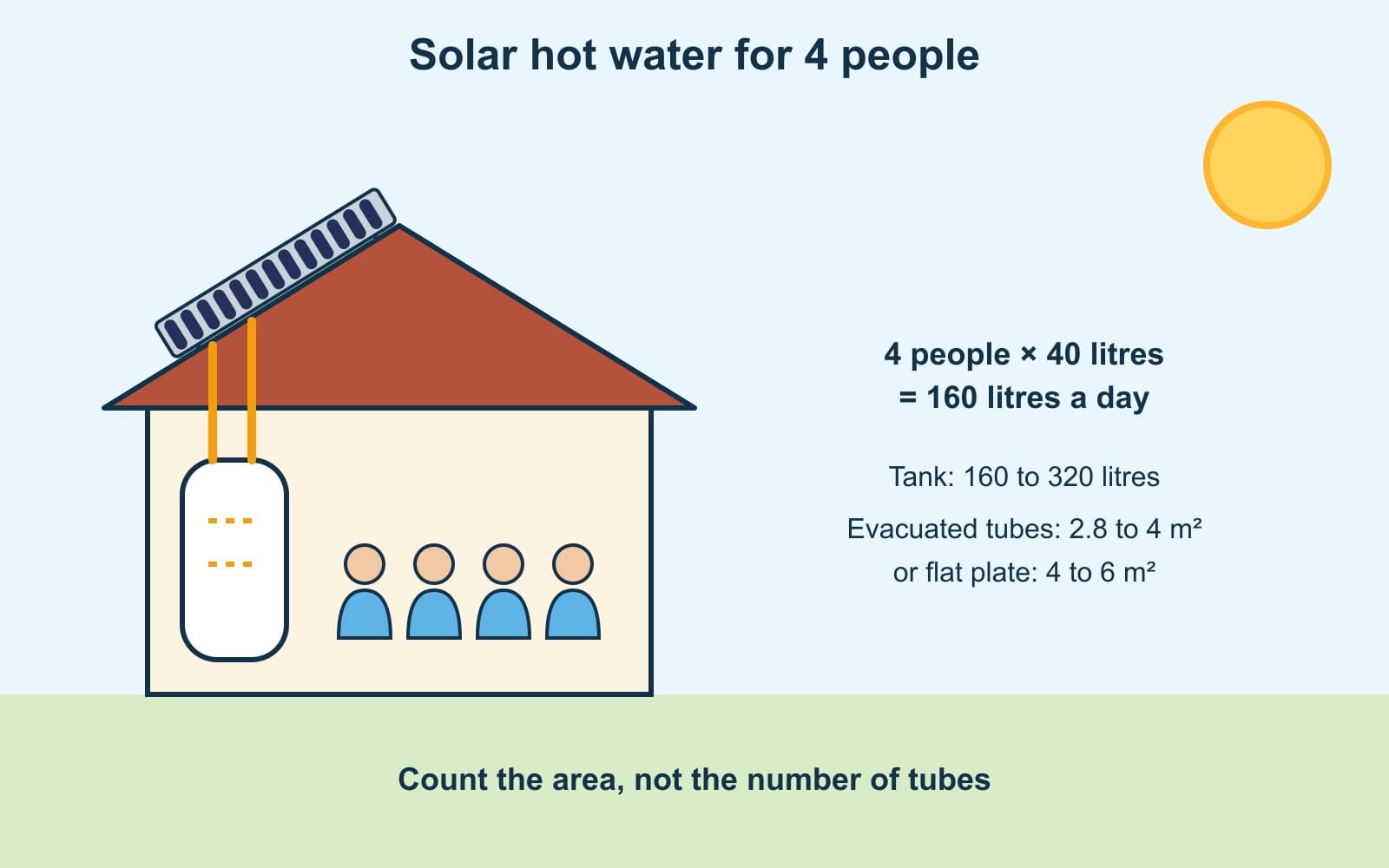
Worked example: a family of 4
- Hot water per day: 4 × 40 = 160 litres (42 gallons).
- Tank for 1 to 2 days: 160 to 320 litres. In its own example, SEAI goes for 2 days: 320 litres (85 gallons).
- Evacuated-tube collector: 4 × 0.7 = 2.8 to 4 × 1 = 4 m² (about 30 to 43 sq ft).
- Or flat plate: 4 × 1 = 4 to 4 × 1.5 = 6 m² (about 43 to 65 sq ft).
SEAI’s example is a home with the collector facing south, no shade and a 45° tilt. If your roof is shaded or faces another way, you need a bit more area.
How much electricity or gas it saves
Heating water takes a lot of energy. The math: it takes 1 BTU to raise one pound of water by 1 °F, and 1 kWh is 3,412 BTU (both figures from the US Energy Information Administration, EIA). Say the water comes in at 15 °C (59 °F) and you want it at 50 °C (122 °F):
- 160 litres of water weigh 352.7 pounds.
- From 59 to 122 °F is 63 °F.
- 352.7 × 63 = 22,220 BTU, and 22,220 ÷ 3,412 = 6.5 kWh a day, at the very least (not counting what’s lost in the pipes and the tank).
A 1,500 W electric water heater would take more than 4 hours a day to supply that. The sun doesn’t provide it all year: in Ireland, according to SEAI, a home system usually covers 50 to 60% of the year’s hot water. In sunnier places, more; but that figure has to be worked out by the installer for your home. To see what your electric water heater uses now, check the appliance energy use chart.
Where to put it
According to SEAI, the best is facing south (in the northern hemisphere; north in the southern) at a 30 to 45° tilt. Turning it southeast or southwest only costs about 5%, and even east or west can work. Shade from trees or buildings does cost a lot: it has to be taken into account in the design.
Common mistakes
- Buying by number of tubes. SEAI says to look at the aperture area in m², not the number of tubes.
- A tank that’s too small. If it can’t hold at least a day’s water, the sun’s heat goes to waste.
- Leaving out the mixing valve. Water from the tank can come out very hot. SEAI says a thermostatic mixing valve must be fitted at the outlet, blending in cold water so it doesn’t scald at the shower and taps.
- Expecting it to cover everything. On cloudy or winter days you’ll need your usual water heater.
When to call an installer
Always, for the installation. A solar water heater has pipework at high pressure and temperature, an expansion vessel and safety valves, according to SEAI. Ask the installer for the collector’s aperture area, the tank size and what share of the year’s hot water they expect it to provide.
Sources and references
- Sustainable Energy Authority of Ireland (SEAI), 2010. Domestic solar systems for hot water: A Consumer Guide (40 litres per person per day, 1 to 2 days of storage, 0.7–1 m² of tubes or 1–1.5 m² of flat plate per person, 50–60% of the year’s hot water, orientation, mixing valve).
- U.S. Energy Information Administration (EIA). British thermal units (Btu) (1 BTU raises one pound of water by 1 °F; 1 kWh = 3,412 BTU).
Frequently asked questions
What size solar water heater do I need for a family of 4?
Using SEAI’s guide, a family of 4 uses about 160 litres (42 gallons) of hot water a day: a 160- to 320-litre (42- to 85-gallon) tank and 2.8 to 4 m² of evacuated tubes or 4 to 6 m² of flat plate.
How many tubes does a solar water heater need for 4 people?
The number of tubes is no way to compare them, because each manufacturer makes them a different size. SEAI says to look at the aperture area: 0.7 to 1 m² of tubes per person, 2.8 to 4 m² for 4 people.
Does a solar water heater provide hot water all year?
Not all of it. In Ireland, according to SEAI, a home system covers 50 to 60% of the year’s hot water. With more sun, more, but on cloudy days you’ll need your usual water heater.


