
In short
- The U.S. Department of Energy table lists 4,500 to 5,500 W for a 40-gallon (151-litre) tank water heater; Argentina’s table (ENRE) lists 1,500 W for a small tank.
- An electric tankless heater needs a huge amount of power: delivering 2 gallons (7.6 litres) per minute with a 45 °F (25 °C) rise takes about 13,000 W.
- What you pay depends on the water you heat: raising 1 litre by 1 °C takes 1.163 Wh. A family of 4 using 160 litres (42 gallons) a day, heated from 59 to 122 °F (15 to 50 °C), uses at least 6.5 kWh a day, about 195 kWh a month.
- A tank also uses energy keeping water hot. That’s why, according to the Department of Energy, a tankless heater can be 24–34% more efficient in a home that uses little hot water.
Words you’ll see
- Heating element: the part that heats the water with electricity, like the one in a kettle.
- Tank (storage) water heater: heats a tank of water and keeps it hot for when you open the tap.
- Tankless (on-demand) water heater: heats water only as it flows through, when you open the tap.
- Standby losses: heat that escapes from the tank even when nobody uses water; the element switches on again to replace it.
- Watt and kWh: the power at any moment and the energy over time. More in watts, kWh, volts and amps.
How many watts is an electric water heater?
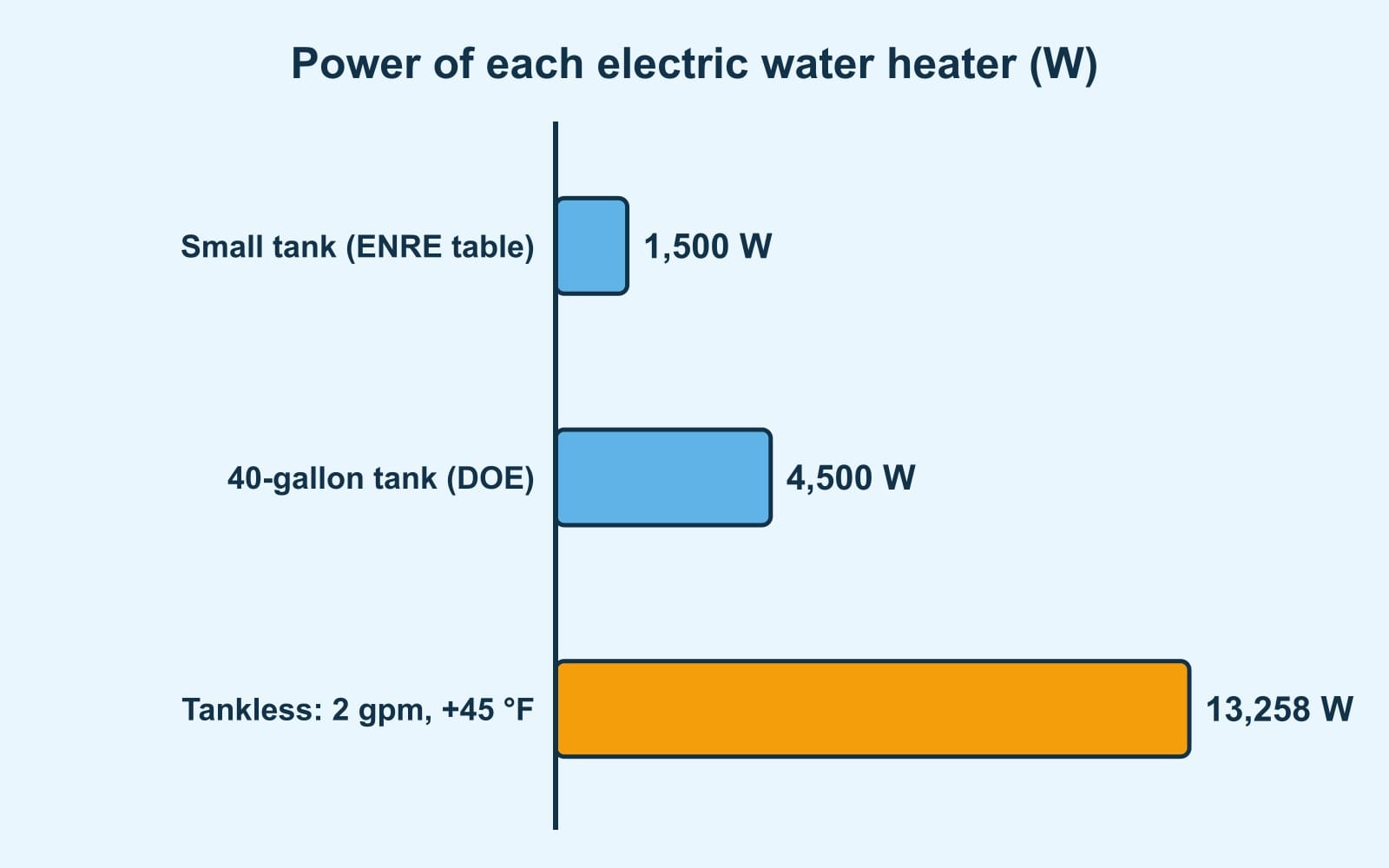
- Small tank: 1,500 W, according to the table from Argentina’s electricity regulator (ENRE).
- 40-gallon (151-litre) tank: 4,500 to 5,500 W, according to the U.S. Department of Energy table reproduced by Virginia Tech. The EWEB utility guide lists 4,500 W.
- Tankless: the Department of Energy says these heaters typically deliver 2 to 5 gallons (7.6 to 15.2 litres) per minute, with gas models giving higher flow rates than electric ones. Instantly heating 7.6 litres per minute by 25 °C takes: 7.6 × 25 × 1.163 Wh × 60 = 13,258 W. That’s why electric models give less flow.
What really sets the bill: volume and temperature rise
Raising 1 litre of water by 1 °C takes 1.163 Wh. It follows from the BTU definition given by the U.S. Energy Information Administration (EIA): 1 BTU raises one pound of water by 1 °F, and 1 kWh is 3,412 BTU. So:
Wh per day = litres × degrees (°C) of rise × 1.163
It doesn’t matter whether the heater is 1,500 or 5,500 W: the more powerful one heats faster, but heating the same water takes the same energy. Power decides how quickly you get hot water, not how much you pay.
Worked example: a family of 4
The Sustainable Energy Authority of Ireland (SEAI) allows 40 litres of hot water per person per day, the same figure we use in our article on solar water heaters for a family of 4.
- Water per day: 4 × 40 = 160 litres (about 42 gallons).
- Temperature rise, from 15 °C (59 °F) at the tap to 50 °C (122 °F): 35 °C (63 °F).
- Energy: 160 × 35 × 1.163 = 6,512 Wh, about 6.5 kWh a day.
- Per month: 6.5 × 30 = 195 kWh, at minimum.
It’s a minimum because it leaves out losses: a tank also uses the heat that escapes from it. In winter, with colder tap water, it goes up. With a 1,500 W tank, those 6.5 kWh are about 4.3 hours of element run time a day: enter those hours in the electricity usage calculator and you’ll get the same result.
Which uses less, tank or tankless?
According to the U.S. Department of Energy:
- A tankless heater has no standby losses. In homes using 41 gallons (about 155 litres) of hot water a day or less, it can be 24–34% more efficient; in homes using a lot, around 86 gallons (about 325 litres), 8–14%.
- It costs more to buy, but typically lasts more than 20 years; a tank heater, 10 to 15.
- Its limit is flow: a shower while the dishwasher runs can stretch it.
Common mistakes
- Thinking the higher-wattage heater costs more per month. Heating the same water costs the same; the more powerful one is just faster.
- Forgetting tank losses. A tank loses heat even when no tap is open, and the element replaces it (Department of Energy).
- Installing an electric tankless heater without checking the wiring. It draws thousands of watts at once: before buying, have an electrician check whether your installation can take it.
When to call an electrician
An electric water heater is one of the most power-hungry appliances in a home. Its wiring, cable size, protection and grounding are a job for a licensed electrician or qualified installer; the Department of Energy also recommends a professional to install tankless units. Call one if the breaker trips when it heats or the water comes out lukewarm.
Sources and references
- U.S. Department of Energy, Energy Saver. Tankless or Demand-Type Water Heaters (checked in its January 1, 2026 archived copy: 2–5 gallons per minute, 24–34% and 8–14% more efficient, more than 20 years versus 10–15, professional installation).
- Grisso, R., Walker, M. and Ignosh, J., Virginia Cooperative Extension (Virginia Tech), 2020. Estimating Appliance and Home Electronic Energy Use (Department of Energy table: 40-gallon water heater, 4,500–5,500 W).
- Ente Nacional Regulador del Gas y la Electricidad (Argentina). Consumo básico de electrodomésticos (electric tank water heater with thermostat, 1,500 W).
- EWEB (Eugene Water & Electric Board, U.S.). Generator Sizing Considerations (electric water heater, 4,500 W).
- U.S. Energy Information Administration (EIA). British thermal units (Btu) (1 BTU raises one pound of water by 1 °F; 1 kWh = 3,412 BTU).
- Sustainable Energy Authority of Ireland (SEAI), 2010. Domestic solar systems for hot water: A Consumer Guide (40 litres of hot water per person per day).
Frequently asked questions
How many watts does an electric water heater use?
A 40-gallon tank heater has a 4,500–5,500 W element, according to the U.S. Department of Energy table; a small tank, about 1,500 W. A tankless one needs far more: about 13,000 W to deliver 2 gallons per minute with a 45 °F rise.
How much does an electric water heater use per month for a family of 4?
At 40 litres per person, 160 litres a day heated from 15 to 50 °C: 160 × 35 × 1.163 = 6.5 kWh a day, about 195 kWh a month at minimum. A tank heater uses somewhat more because of the heat its tank loses.
Does a tankless water heater use less?
It heats the same water with the same energy, but doesn’t lose heat storing it. According to the U.S. Department of Energy, it can be 24–34% more efficient in homes using 41 gallons of hot water a day or less.


